Our Mission:

Our Mission: To enable individuals and communities to take an active part in the cultivation of systems that provide the highest quality fruits, vegetables, herbs and other yields, in a way that benefits themselves, cares for the land and environment, and provides a surplus to use, share and reinvest into the system.
Showing posts with label Produce. Show all posts

Thursday, October 17, 2024

Iowa Lemons!

Lemons can be a lot of fun to grow in Iowa!  Wait, what!?  That can't be right...


Unless you live in a tropical or semitropical climate the idea of growing your own lemon tree might seem impossible.  It may not be possible to grow a citrus in the ground here (without some serious effort*) but we can easily grow them, in pots!


These wonderful trees can be a unique addition to any home.  By growing a small lemon tree in a container, you'll be able to get homegrown lemons with limited space, even in the Midwest.  In addition to lemons, the flowers are beautiful and smell amazing! 


Lemon trees actually have pretty good cold and heat tolerance, but our winters get cold, and they need to come indoors.  Growing lemon trees in pots allows them to be mobile.  Having a "mobile home" won't mean they can head south for the winter, but it does allow them to "migrate" to the inside. 

In summer you can put them on your patio, deck or an open area by your vegetable garden.  An apartment balcony can be great too, especially for those who have limited access to other kinds of gardening.  Besides a few citrus trees, I also keep lemongrass, rosemary and bay laurel on our deck.
Almost like a container food forest!

As the weather starts to cool off simply bring them indoors for the winter.  When the temperature gets down below 50°F I'll make plans to bring them in, a frost can be deadly to a potted citrus tree.  Check for aphids, spider mites and scale so you don't bring those in with your tree.  A spray with insecticidal soap usually does the trick.  If your citrus tree drops some or many of their leaves when moved indoors at the end of the growing season, don't worry!  This is a natural response as the tree adjusts to different light levels.


When the late winter months start to seem extra, extra-long you can enjoy the bright, citrus fragrance and think of warmer days soon to come.  With proper care, growing a lemon tree in a pot is easy enough that you can do so anywhere.  
Even in Iowa...

Tuesday, March 12, 2024

Secluded Woodland Oasis & Gardens

After their new addition was built, these Urbandale homeowners saw it as their chance to include some new outdoor elements they wanted instead of just repairing the construction damage.

Patio, bench wall, garden beds and stream behind

It included a patio with bench walls and a firepit, vegetable and herb gardens.  A dry stream directs stormwater runoff to a pair of rain gardens.

Upper rain garden basin ready for planting

Bridge set over the rain garden outlet
to access the existing woodland paths

In the production area, herb beds run along the access path at ground level and are just at the edge of the available sunshine.  The raised vegetable beds benefit from being a bit farther away from the house's shadow, and being elevated helps to get more sun on them too.  Trellises were also added for some vertical growing space.  

The block used on these beds is durable, looks great
and compliments the patio and bench walls!

The garden beds were going in near an existing Hackberry tree and I was concerned about tree roots invading and stealing water and nutrients from them.  


A Rain Barrel catches rain for use in the gardens

The rain barrel overflows into the downspout drain that connects to the lower rain garden basin behind the raised beds.  Shade loving plants were predominantly used throughout the rain garden plantings - columbine, woodland phlox, sedges and wild geranium.  A few pockets got more sun, so we could try for some more color using part sun and native savannah plants - cardinal flower and bee balm.


Thanks to Beemer Landscaping on the hardscaping assist!


We also cut and removed lots of invasive honeysuckle filling several dump trailers worth.

Reusing saved materials was high on the list of customer desires.  The patio stone was selected to match pavers leftover from a previous landscaping project.  These existing pavers were incorporated into the access path to the side yard, gardens and rain barrel.

Leftover pavers and stone from a previous
project we used for edging and steppers

Several pallets of assorted limestone served as edging along the access path above, and a walking path expansion loop through the side yard along a new planting bed and retaining wall.

Dark trap rock contrasts well against pale limestone,
but it's dusty!


The construction access was cleared of wood chips last fall.  After the temporary driveway was used for a needed tree removal, it was dormant seeded this Winter with a customized woodland sedge and wildflower mix.  Timing was perfect with 4" of snow falling that night.

We love how it has turned out so far, and excited for fresh growth and blooms this season!


Friday, February 9, 2024

Parking Pad to Garden Transformation

These new homeowners had an idea for their backyard, and it didn't include the existing gravel parking lot.


They also had significant yard damage from a geothermal system, that was not repaired the way they had expected.


The goal was for a natural, relaxing space filled with as many edible and ecological benefiting elements as possible.

We began with three main goals- a garden, a patio and a fence.  Garden beds were high on the priority list for clean growing fresh produce!  A relaxing patio for their firepit, surrounded by a natural environment using some of their existing plants and lots of new natives.  A future fence was planned to separate the new space from alley noise and traffic.


Many edible plants were hoped for both in the garden area and even around the yard.  We put in as many perennial and edible plants as practical for this space.  Rhubarb, asparagus, berries and even an apple tree.

Initial site work involved removing the gravel and breaking up the compaction of years of traffic.  We left a circle of the existing pad for the base of the new paver patio.
 

A keyhole style bed maximizes growing space on a smaller overall footprint.  

Raised frame beds allowed us to bring in a fresh mix of clean soil to grow in.


We added compost to the remaining planting areas to add organic matter, build soil structure and workability, as well as encourage soil life.


With a limited space and south facing wall, this was a perfect space to espalier an apple tree.  The downspout from the garage allowed us to capture rainwater for use right by the garden.


Companion plants were included in this tree guild -
    Yarrow to attract beneficial insects
    Clover for nitrogen fixing action
    Chives to protect the trunk from rabbits
    Other herbs for their antimicrobial benefits

A decorative Japanese Maple was the focal point for the back corner with an Asian palette, a Serviceberry up front for a native edible shrub and multiple species of native woodland and savanna plants along the neighboring garage.  Bee Balm is great addition against the patio as it repels mosquitoes and feeds beneficial pollinators, and dwarf varieties soften the edge from lower to higher plantings.  Narrow evergreens will frame the future access gate and provide shades of green in the winter.

Great work on the patio from Ben's crew at Beemer Landscaping

We had just completed another project where a large amount of sod was removed.  So, after leveling the damage to the side yard we were able to upcycle it here instead of only reseeding.


The stepper path was re-laid through the damaged lawn area, using the existing pieces and we were able to match extras we needed.  The path was also extended from the back sidewalk to the patio area and gate.  


Finally, everything was mulched and finished.  A few weeks of garden care during their vacation, and then an additional Redbud tree for more afternoon shade.  It was all ready for the privacy fence install.

Paver patio backed by a Japanese maple

Raised bed garden behind the existing hedge

Pollinator friendly prairie natives benefit the garden too


A little taste of Eden in the heart of our city.  If you like this project or our others, we'd love it if you shared it with your friends!

This visitor couldn't wait for us to be done :)
Swallowtail butterfly getting a drink


Friday, January 12, 2024

Gardens vs Tree Roots

Durable block wall raised beds with...  Under Armor !?!?

These garden beds, installed this summer, were going in near an existing Hackberry tree.  Although near the current drip line, the footprint was small, and the installation shouldn't damage its roots any more than the other construction traffic.  

However, future growth would mean that the root system would be expanding.  I was concerned about these tree roots invading the raised beds and stealing water and nutrients from the plants growing there.  

Original SPROUT Garden

At the old Sprout Garden location, nearby Oak trees had nearly filled the existing raised beds with roots.  The tending gardeners said yields had gone down over the years, but guessed it was due to diminishing soil quality and fertility over the years.  

When we reclaimed the wood to use in the new project, we found that the remaining soil was almost a solid "loaf" of tree roots!


I've have also dealt with them in my own garden as well.  Maple trees love to send out exploring feeder roots!


To address this potential problem, we wanted to create an air gap to encourage air pruning of the tree roots instead of letting them invade the growing bed. 


The gap would be filled with river rock to maintain larger airspaces to discourage invading roots yet support the growing mix above.  Starting at the bottom -
  1. We added heavy fabric to keep the rock separated from the existing soil.
  2. Then we added a 2-4" layer of river rock, to keep air pockets open.
  3. Before filling the beds with soil, another layer of fabric was added.
If the growing mix was allowed to settle into the rock it would eliminate the desired airspace.


The vegetable beds are situated just outside the house's shadow most of the year, and being elevated helps to get more sun on them too.  

Trellises were added for some vertical growing space.


More to updates to come on this project!

Friday, February 12, 2021

Drake University Food Forest and Sprout Garden

New trees in the mixed orchard space at Sprout

Sprout: The Des Moines Urban Youth Learning Garden at Drake University was established in 2012 through the work of environmental science students and a grant from the State Farm Youth Advisory Board.  It serves as a community hub for environmental education and healthy food access for the neighborhood surrounding Drake University.  Produce from the garden is donated to the community through the Little Free Pantry, the Boys and Girls Club, and to students and volunteers.

Previous location on Forest Avenue

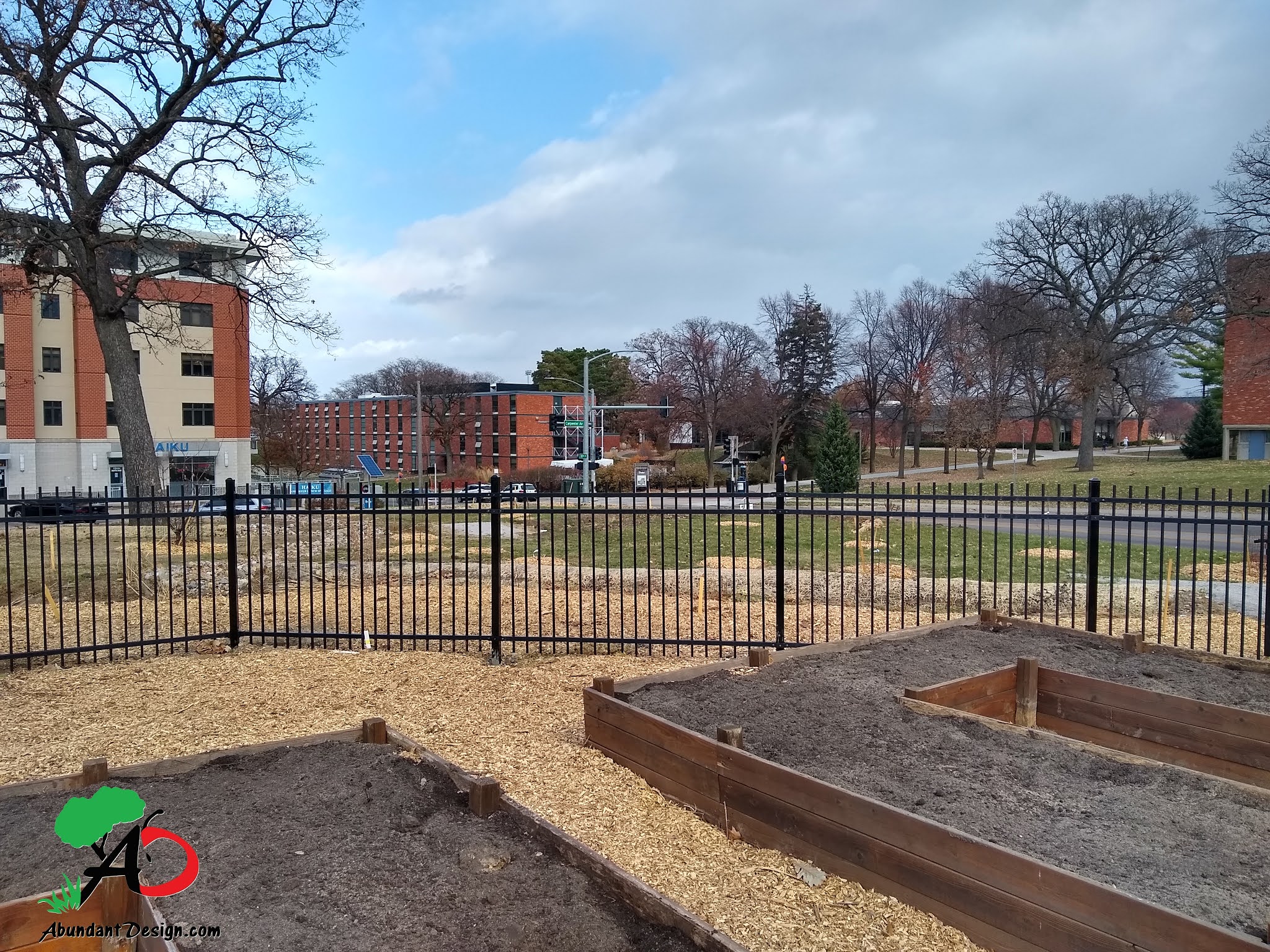
The Sprout Garden was originally located on Forest Avenue, near the Knapp Center and Boys & Girls Club, but due to new development the Sprout Garden had to be relocated.  The new location at 30th & Carpenter is a prime location as the gateway to campus.  The move also offered an opportunity for a redesign and introducing new features.  Through word of mouth and our previous work at DMACC, Abundant Design was selected for the project.

Campus "Gateway" on 30th St off University Ave

Meetings were virtual, budgets and timelines were tight.  Permits & getting approvals pushed back the start date, and approaching winter could put a hard stop on the installation.  Trying to reuse and bring over from the existing location as possible we took inventory of what we could salvage.  Ideas and possibilities were discussed among potential interested parties, with the current open space redesigned through several rough drafts into a food forest park, with permaculture tree guilds, runoff capturing rain gardens and gathering spaces.

Work began with new site prep, grading and rainwater catchment to hydrate the parched lot and manage stormwater.

Site assessment and beginning dirt work

Snow and rain helped confirm soil infiltration rates after construction

Student volunteers helped move native plants over to supplement the rain garden plantings.

Final overflow - three rain gardens double as On Contour Swales 

The garden shed was next, along with the rain barrel, and a new gathering/presentation space. Almost stadium style bench seating was built with the limestone brought over.  The existing gingko trees from the green space were moved into the parkway for street trees requirement.  This conserved budget and gave us lower growing trees as not to shade the garden production areas.

The Drake facilities team members were great to work with, and getting the shed and arbors moved.


That early first snow gave me a scare that the nice weather wouldn't last!

But luckily it did!

Garden beds were modified from the previous rectangular beds (seen above) to keyhole beds using the aged but mostly reclaimed lumber.  These keyholes allow for easier access to the plantings while increasing overall growing area, all with a smaller overall footprint.

Keyhole raised bed construction

Wood cores will give them an almost hügelkultur effect, feeding beneficial fungi and helping to retain/wick moisture.

Aged wood lined beds and fungal activity

At the end of Season one had the garden space moved and a great start on the mainframe of the forest garden park.

Arbor entry into the gardening area

Raised beds, in-ground grow space, fence with orchard behind
Teaching space with limestone benches off shed

You can follow the Sprout Garden on 
Facebook for gardening tips, community resources and volunteer opportunities.