Our Mission:

Our Mission: To enable individuals and communities to take an active part in the cultivation of systems that provide the highest quality fruits, vegetables, herbs and other yields, in a way that benefits themselves, cares for the land and environment, and provides a surplus to use, share and reinvest into the system.
Showing posts with label Abundance. Show all posts

Thursday, October 17, 2024

Iowa Lemons!

Lemons can be a lot of fun to grow in Iowa!  Wait, what!?  That can't be right...


Unless you live in a tropical or semitropical climate the idea of growing your own lemon tree might seem impossible.  It may not be possible to grow a citrus in the ground here (without some serious effort*) but we can easily grow them, in pots!


These wonderful trees can be a unique addition to any home.  By growing a small lemon tree in a container, you'll be able to get homegrown lemons with limited space, even in the Midwest.  In addition to lemons, the flowers are beautiful and smell amazing! 


Lemon trees actually have pretty good cold and heat tolerance, but our winters get cold, and they need to come indoors.  Growing lemon trees in pots allows them to be mobile.  Having a "mobile home" won't mean they can head south for the winter, but it does allow them to "migrate" to the inside. 

In summer you can put them on your patio, deck or an open area by your vegetable garden.  An apartment balcony can be great too, especially for those who have limited access to other kinds of gardening.  Besides a few citrus trees, I also keep lemongrass, rosemary and bay laurel on our deck.
Almost like a container food forest!

As the weather starts to cool off simply bring them indoors for the winter.  When the temperature gets down below 50°F I'll make plans to bring them in, a frost can be deadly to a potted citrus tree.  Check for aphids, spider mites and scale so you don't bring those in with your tree.  A spray with insecticidal soap usually does the trick.  If your citrus tree drops some or many of their leaves when moved indoors at the end of the growing season, don't worry!  This is a natural response as the tree adjusts to different light levels.


When the late winter months start to seem extra, extra-long you can enjoy the bright, citrus fragrance and think of warmer days soon to come.  With proper care, growing a lemon tree in a pot is easy enough that you can do so anywhere.  
Even in Iowa...

Tuesday, March 12, 2024

Secluded Woodland Oasis & Gardens

After their new addition was built, these Urbandale homeowners saw it as their chance to include some new outdoor elements they wanted instead of just repairing the construction damage.

Patio, bench wall, garden beds and stream behind

It included a patio with bench walls and a firepit, vegetable and herb gardens.  A dry stream directs stormwater runoff to a pair of rain gardens.

Upper rain garden basin ready for planting

Bridge set over the rain garden outlet
to access the existing woodland paths

In the production area, herb beds run along the access path at ground level and are just at the edge of the available sunshine.  The raised vegetable beds benefit from being a bit farther away from the house's shadow, and being elevated helps to get more sun on them too.  Trellises were also added for some vertical growing space.  

The block used on these beds is durable, looks great
and compliments the patio and bench walls!

The garden beds were going in near an existing Hackberry tree and I was concerned about tree roots invading and stealing water and nutrients from them.  


A Rain Barrel catches rain for use in the gardens

The rain barrel overflows into the downspout drain that connects to the lower rain garden basin behind the raised beds.  Shade loving plants were predominantly used throughout the rain garden plantings - columbine, woodland phlox, sedges and wild geranium.  A few pockets got more sun, so we could try for some more color using part sun and native savannah plants - cardinal flower and bee balm.


Thanks to Beemer Landscaping on the hardscaping assist!


We also cut and removed lots of invasive honeysuckle filling several dump trailers worth.

Reusing saved materials was high on the list of customer desires.  The patio stone was selected to match pavers leftover from a previous landscaping project.  These existing pavers were incorporated into the access path to the side yard, gardens and rain barrel.

Leftover pavers and stone from a previous
project we used for edging and steppers

Several pallets of assorted limestone served as edging along the access path above, and a walking path expansion loop through the side yard along a new planting bed and retaining wall.

Dark trap rock contrasts well against pale limestone,
but it's dusty!


The construction access was cleared of wood chips last fall.  After the temporary driveway was used for a needed tree removal, it was dormant seeded this Winter with a customized woodland sedge and wildflower mix.  Timing was perfect with 4" of snow falling that night.

We love how it has turned out so far, and excited for fresh growth and blooms this season!


Tuesday, February 20, 2024

Tap Those Trees - with Video

Each year at the end of winter and beginning of spring, there are a few weeks of magic that happens.  Tree sap starts to flow, bringing life from the roots back into the branches. Farmers across the northern US and Canada collect sap from their maple trees as they have for over two hundred years.  

The sap is collected and usually taken to their "Sugar Shack." There, this barely sweet, clear sap is boiled down using time-honored methods passed down from generation to generation to produce the sweet, dark maple syrup we use on pancakes, waffles and more.

You can also take part in this historical tradition right in your own backyard (or a friendly neighbors)!


This week's forecast looks great!

Sugar maples are best, with typically higher sugar content in the sap, but I had a garden design customer tell me he got over 40 gallons from a large silver maple in his yard!  I think our tree is probably an Autumn Blaze hybrid maple from the looks of the fall foliage and how common they are in the suburbs.

Our Maple Tapping Display at the
2016 Home & Outdoor Living Show


You can also tap Birch, Black Walnut and I've even heard of Butternut trees for uniquely flavored syrup.

Buy your Spiles, or Tree Taps, just like mine - HERE

These Hook Spouts are especially designed to hold pails with holes smaller than ¾ inch. The hook slides on behind the washer.


This video from our backyard tree demonstrates a simple "how-to" tapping method for you-

From the Northern Midwest to New England and into Canada, the sap is boiled down into Maple Syrup.  This is often done in large pans over an open flame outside, as boiling sap into syrup produces a lot of steam.  And it takes a lot of fuel.  Sap is continuously added as the water is boiled off, carefully making sure it doesn't boil over or burn the pan.  It typically takes around 40 gallons of sap to make one gallon of syrup.

If you have access to enough trees and want to try making some syrup yourself, here is a great guide from the University of Maine Extension Service.

How to Tap Maple Trees and Make Maple Syrup (link) 


We just drink the sap since we don't have many trees and its high in minerals, other nutrients, enzymes, antioxidants, and more—an incredible, all-natural beverage with less than 2% sugar!

You can learn more about Drinking Maple 

(and other sap) at Chelsea Green (link)


If you want to experience it in person the Indian Creek Nature Center near Cedar Rapids is having a Maple Syrup Festival on March 23 & 24 this year.

41st Annual Maple Syrup Festival (link)


Enjoy the tastes of the season!

Friday, February 9, 2024

Parking Pad to Garden Transformation

These new homeowners had an idea for their backyard, and it didn't include the existing gravel parking lot.


They also had significant yard damage from a geothermal system, that was not repaired the way they had expected.


The goal was for a natural, relaxing space filled with as many edible and ecological benefiting elements as possible.

We began with three main goals- a garden, a patio and a fence.  Garden beds were high on the priority list for clean growing fresh produce!  A relaxing patio for their firepit, surrounded by a natural environment using some of their existing plants and lots of new natives.  A future fence was planned to separate the new space from alley noise and traffic.


Many edible plants were hoped for both in the garden area and even around the yard.  We put in as many perennial and edible plants as practical for this space.  Rhubarb, asparagus, berries and even an apple tree.

Initial site work involved removing the gravel and breaking up the compaction of years of traffic.  We left a circle of the existing pad for the base of the new paver patio.
 

A keyhole style bed maximizes growing space on a smaller overall footprint.  

Raised frame beds allowed us to bring in a fresh mix of clean soil to grow in.


We added compost to the remaining planting areas to add organic matter, build soil structure and workability, as well as encourage soil life.


With a limited space and south facing wall, this was a perfect space to espalier an apple tree.  The downspout from the garage allowed us to capture rainwater for use right by the garden.


Companion plants were included in this tree guild -
    Yarrow to attract beneficial insects
    Clover for nitrogen fixing action
    Chives to protect the trunk from rabbits
    Other herbs for their antimicrobial benefits

A decorative Japanese Maple was the focal point for the back corner with an Asian palette, a Serviceberry up front for a native edible shrub and multiple species of native woodland and savanna plants along the neighboring garage.  Bee Balm is great addition against the patio as it repels mosquitoes and feeds beneficial pollinators, and dwarf varieties soften the edge from lower to higher plantings.  Narrow evergreens will frame the future access gate and provide shades of green in the winter.

Great work on the patio from Ben's crew at Beemer Landscaping

We had just completed another project where a large amount of sod was removed.  So, after leveling the damage to the side yard we were able to upcycle it here instead of only reseeding.


The stepper path was re-laid through the damaged lawn area, using the existing pieces and we were able to match extras we needed.  The path was also extended from the back sidewalk to the patio area and gate.  


Finally, everything was mulched and finished.  A few weeks of garden care during their vacation, and then an additional Redbud tree for more afternoon shade.  It was all ready for the privacy fence install.

Paver patio backed by a Japanese maple

Raised bed garden behind the existing hedge

Pollinator friendly prairie natives benefit the garden too


A little taste of Eden in the heart of our city.  If you like this project or our others, we'd love it if you shared it with your friends!

This visitor couldn't wait for us to be done :)
Swallowtail butterfly getting a drink


Friday, March 3, 2023

Backyard Retreat & Woodland Adventures

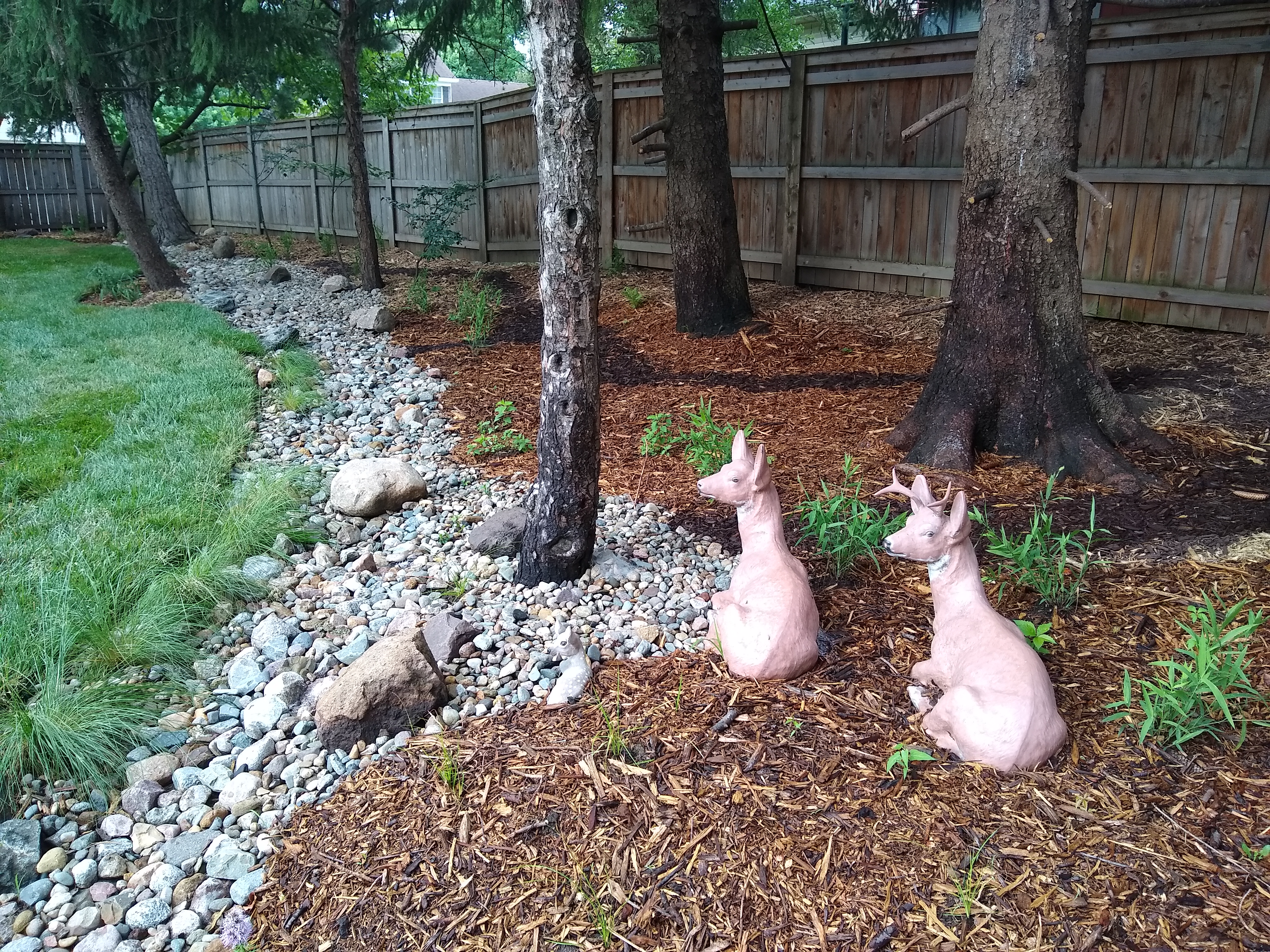
Dry play yard, decorative and functional stream
with a woodland adventure area behind

Wet + Shade + High Traffic

These things never lend themselves to a healthy lawn...  A lawn is definitely something the homeowners wanted out of this project for their kids' soccer and football games.  But in addition to the lawn, they wanted a space for creative play, keeping or expanding the existing vegetable gardens, increasing the numbers of edible berries and plants, all while doing it in a natural and earth-friendly sort of way.


Before pics-

Heavy shade, traffic and excessive moisture
make turf grass struggle to thrive


Deeper shade and low growing branches
Garden space, with bland spirea along the house


These bushes on the back window were lanky and just not very interesting, they were hoping for something better, maybe even edible.  The blueberries they already had were doing great!  We decided on a trio of 'Regent' Serviceberry for variety, a hardy native that also produces delicious berries.


This area was also in heavy shade from a maple tree with an expansive canopy.  Grass had always struggled along this access area in and out of the backyard, too.  Maybe we could use the 'problem as the solution' and just take the turf grass out of the equation for this part of the yard?


Solutions- 

The shade was hindering the lawn from drying out, but the cause of the initial wetness was downspouts pouring into the yard, shallow slope preventing proper drainage and a large amount of runoff from a neighboring hillside.

We could reroute the runoff from both uphill and the downspouts, utilize the city rebate program and create multiple spaces for adventurous play, pollinator habitat and a natural feeling space that felt more like a nature park than the suburbs. 

Many shrubs had volunteered along the back property line, including dogwood, mulberry and highly invasive honeysuckle.  We removed most of these, except a few pagoda dogwood that happened fit where they were.
I love using the stump bucket to remove honeysuckle!

We raised the canopy on the evergreens to open up the feel, leaving some climbing rungs for tree borne adventures.  You can also see the grading for the swale that will push water to the rain garden and away from the lawn.

A designated walkway - the "jungle path" as the kids called it - was made using a darker shade of mulch, which will allow traffic in the area but keep the new plantings from being trampled.
Tripod sprinklers kept the newly installed plants and sod
hydrated during the long, hot and dry peak of summer.

Stream installed, fescue sod going in for the final touch

A rain garden captures the runoff and sinks it into the ground
instead of flooding the neighbors and storm sewer system


Remember the shady access way where grass struggled?  We created a woodland garden with a limestone path for access.  We were lucky and could use mostly reclaimed limestone steppers found under the volunteer shrubs.  The nearby downspouts were routed to this space where native shade loving plants won't mind the extra moisture - including ferns, sedges and wild geranium.  A couple gooseberry shrubs won't mind the shade either and provide a seasonal snack for adventurous young explorers.
Shade tolerant access path planting


In addition, the front planting island around the flagpole was overgrown with a massive burning bush (also invasive), volunteer mulberries and plastic edging that had seen better days (no before picture).  Tumbled granite added an updated and durable edge to this bed.  All of the existing vegetation was removed and replaced with Midwest native plants, like an Aronia bush and New Jersey Tea tree.  Butterfly milkweed, rudbeckia and echinacea were among the flowering forbs, with switchgrass for height and textural contrast in the center and fronted by lower growing clumps of prairie dropseed.


The shade on this project was very welcome during this summer's heat!