Our Mission:

Our Mission: To enable individuals and communities to take an active part in the cultivation of systems that provide the highest quality fruits, vegetables, herbs and other yields, in a way that benefits themselves, cares for the land and environment, and provides a surplus to use, share and reinvest into the system.

Saturday, March 14, 2015

Fitness for Gardening

Welcome back!
This week I have a great follow-up to our Nutrition Month post.  We are going to look at getting winter weary muscles back in shape for this years gardening season.  For this week's post, I've enlisted the help of a couple of my fitness and bike riding friends to put together these exercises to get our bodies "garden ready."
 Note: Always consult a qualified medical professional before beginning any exercise program.

Fitness for Gardening
For those of you that love to garden, we have a strengthening and stretching program that is just for you!  You put in the time and effort into improving the health of your garden.  Now let’s use this gardening specific program to produce a healthier you.
Studies shown that continuous movement through moderate physical activity such as gardening for 30-50 minutes 3-5 days of the week can have significant health benefits. Some of those health benefits are listed below.

Health Benefits
   * Decreased risk of high blood pressure
   * Decreased risk of diabetes
   * Contributing to healthier bones, muscles and joints

In addition to taking care of your cardiovascular health, it’s important to consider strength and flexibility exercises to add in the reduction of potential injuries. Below is a list of exercises for strengthening and lengthening the muscles to help improve the comfort of the gardening experience.


Special thanks for this weeks post go to:
   Troy Henrich, CSCS, NSCA-CPT
   Meagen Kirts, ATC; Exercise Physiologist, ACSM; Fitness Nutrition Specialist, ACE

Have a great week!


Sunday, March 8, 2015

Nutrition Month

Bulbs peeking through
Spring isn’t waiting for the calendar or following the groundhog’s prediction this year, at least that is how this week's forecast looks.  Our garlic, tulips and crocuses are popping through.  Now would be good a time to get those birdhouses we made hung out so when our migrating visitors return they will know where the best nesting sites are.

March is Nutrition Month
Nutrition provides the essential macronutrients (Protein, Carbohydrates, Fats, Vitamins and Minerals), micronutrients and other substances in food that provide our bodies' needs for energy, maintenance and health.  Good nutrition is the proper proportions of these; poor nutrition is when these are out of balance.
 
Poor nutrition has been linked to chronic problems, such as diabetes and cardiovascular disease.  According to the US Department of Health and Human Services, unhealthy eating and inactivity contribute to well over 300,000 deaths each year!  That's about the same as tobacco, and 13 times as many as are killed by guns
 
Good nutrition is key for optimal health, athletic performance, disease prevention and overall well-being.  There are many guidelines about what constitutes a healthy diet, with a fair amount of debate on many of the details.  But one thing is consistent-
  
"Eat your fruits and vegetables!" 
Fruits and vegetables are at the top of nearly every set of healthy eating guidelines and recommendations, for good reasons.
          -Vitamins Minerals Fiber AntiOxidants Phytochemicals
          -Most fruits and vegetables are lower in fats and calories, and are filling
          -Diets high in fruits and vegetables are linked to lower incidences of cancer, cardiovascualar disease and diabetes
 
Try these fun printable activities for your kids, from the USDA:
 
Fresh produce is at its peak of flavor and nutrition! 
Farmers Market Season is also just around the corner.  These are a great opportunities to get super fresh fruits and vegetables.  They also are a good chance to get to know your farmer and their growing practices, which builds community and gives you a chance to learn their growing practices.  You can also find fresh produce through a local CSA (Community Supported Agriculture) farm or roadside farm stands.
 
 
Ultimate Freshness
For the ultimate in freshness, consider growing your own!  No one can grow and deliver fresher fruits and vegetables than you can get from your own yard.  Herbs gathered from the deck or patio plantings, tomatoes picked out of the vegetable garden, or even the apple you pick and eat as you walk around your backyard will be bursting with flavor and loaded with nutrition.  You'll also know its history and all that went into its production, giving you peace of mind. 

Apples sliced for homemade applesauce
Now is the time to be planning your garden layout and starting your peppers, tomatoes and other things that need to be given a head start indoors.  It's also a good time to order that fruit tree you've been wanting as nurseries still have most varieties available.  The best time to plant a tree was 20 years ago, the second best time is this year!
 
If you don't think you'll have time or are afraid you'll put it off again this year, now is also a perfect time to contact me to plan a design and landscape installation.  Like I said before, most varieties of trees are still available and selection will become more limited as time passes.  I can also install compost bins or rain barrels to help you live a more sustainable lifestyle.
 
 
"Healthy, sustainable food production methods give us food that is nutritionally better and with fewer pesticides, antibiotics, and hormones." Marion Nestle

Sunday, March 1, 2015

March 2015

Yesterday's inaugural seed exchange went well, and the enthusiasm of the exchangers was truly amazing!

THANK YOU ALL SO MUCH FOR COMING AND SUPPORTING THIS EVENT!!!

Also, thank you to the Waukee YMCA for letting us use their Community Room.

There were TONS of seeds!  Many flower seeds, purely ornamental as well as edible flowers, were brought in.  Three tables were filled with seeds for vegetables, fruits and even trees.  Everything from new and leftover store bought packages to smaller and expertly labeled packets from area seed savers.  Guests stayed and talked about all sorts of topics ranging from homestead planning, fruit tree grafting, rainwater collection and guerrilla gardening.

Congratulations to our prize winners - Jessica, Willow, Bailey and Cory!!! ...and I'm glad the sprinkler timer went to the one who wanted it most! 

I had a lot of fun myself.  Even better, this event taught me what worked and how to make an event like this better, and gave some ideas for similar gatherings and even more.


We have another event planned for this weekend!  Friday night, I will be giving a talk on gardening and edible landscaping projects at the Area 515 Maker Space in downtown Des Moines.  For more information, go to the events page or to the Facebook event page.

Spring will finally arrive this month, but don't grab your trowels just yet.  Our average last frost is between April 20-30.  For help determining when to plant your seeds you can follow this link to the Old Farmer's Almanac.  I've got bell peppers started, onions just germinating, and some tomatoes and jalapeƱos I picked up at the exchange just planted today.

Other odds and ends:
Although I'm not a fan, don't forget to set your clocks ahead when you go to bed this coming Saturday night for the beginning of Daylight Savings Time.

Here's a new video from the USDA-NRCS that I enjoyed.  It highlights the holistic or systems approach to agriculture, versus the symptom and cure style we often find ourselves in.
It still talks about herbicide usage, but if we could get most of the growers in the US to adopt these practices we would be so far ahead of where we are now.  I know that's not the end goal, but its a start!  Vector changes...

Have a great week!

Sunday, February 22, 2015

Purslane - Underappreciated Plants & "Weeds"

Can you tell I am ready for Spring?  You might be thinking,

"He's so ready, he's doing a video about a WEED!"
 
 
What is a weed? A plant whose virtues have never been discovered. - Ralph Waldo Emerson
 
According to Merriam-Webster.com the definition of a weed is:  a plant that is not valued where it is growing and is usually of vigorous growth; especially :  one that tends to overgrow or choke out more desirable plants

http://nutritiondata.self.com/facts/vegetables-and-vegetable-products/2604/2
Raw Purslane 1cup
Nutrition Data, Self.com

So, the location of growth is a true factor in the label of weed.  Sadly, many plants get labeled as weeds regardless of where they grow.  Many plants have acquired the label, "Weed" or "Invasive" that are actually quite beneficial; especially in our population that loves a manicured lawn or weed free fields.

Purslane is a "weed" that actually has many nutritional benefits and is a good source of heart healthy Omega-3 fatty acids, somewhat rare in plants.  It can be used in stews as a thickening agent, and as a topical ointment similar to aloe vera. 

Learn more in this video (look, no snow!)

 
Here is the link and abstract from the journal Phytochemistry http://www.ncbi.nlm.nih.gov/pubmed/22683318

Abstract: "...Portulacanones A-D is the first group of homoisoflavonoids so far reported from the family Portulacaceae. They represent a rare subclass of homoisoflavonoids in nature with a structural feature of a single hydroxyl group substituted at C-2' rather than at C-4' in ring B of the skeleton. Three homoisoflavonoids and the known compound 2,2'-dihydroxy-4',6'-dimethoxychalcone selectively showed in vitro cytotoxic activities towards four human cancer cell lines..."
I encourage you to plant or leave some underappreciated plants here and there in your landscapes.  If they are in a spot on purpose, they are no longer a "weed." Show others their subtle beauty and share the knowledge of their benefits.  You might even have the opportunity to share them with guests in a meal.

If you would like help with an edible and sustainable landscape, with a few surprises hidden in, contact me and I will help you get started, with a design or even a full installation and maintenance plan.

Don't forget the Seed Exchange is this coming weekend!  Have great week!
 

Monday, February 16, 2015

Happy President's Day

https://www.mountvernon.org/
George Washington at Mount Vernon
On February 16th the US will celebrate President's Day.  It is also the birthday of George Washington, our first President under our current Constitution.  Our first four Presidents were passionate botanists.  Washington and Thomas Jefferson, our third President, owned some of the largest and most famous estates in America, Mount Vernon and Monticello respectively.

George Washington was a farmer and avid gardener, owning the 8000 acre Mount Vernon estate and farm.  Click here for a Virtual Tour and much more. In addition to being an innovative farmer, Washington was an accomplished landscape designer drawing praises from Mount Vernon's visitors. He planned flower and kitchen gardens, parterres, as well as a greenhouse and small test garden where he kept various plants he was experimenting with. 
"...to be a cultivator of Land has been my favorite amusement" Washington wrote.

http://www.nps.gov/nr/travel/presidents/adams_nhp.html
John Adams
John Adams was a very influential Founding Father.  Earlier in his career he had worked for several Boston newspapers under the penname "Humphrey Ploughjogger," extolling the virtues of farm life and the cultivation of hemp.  He (as well as Washington) was also interested in compost, and in his letters home he wrote recipes including seaweed, marsh mud, potash and manure, along with animal bedding straw and kitchen scraps.  As the first President to live in the White House, he ordered the first planting of it's garden.  As he was there for only four months the annual vegetable garden was all he had time to do.  As a valued statesman his duties required him to be gone from home much of the time and much of the farm management was left to his wife, Abigail.  In 1801 at the end of his term as President, Adams now 66 returned to the home farm.  He died 25 years later on the 50th anniversary of the signing of the Declaration of Independence.

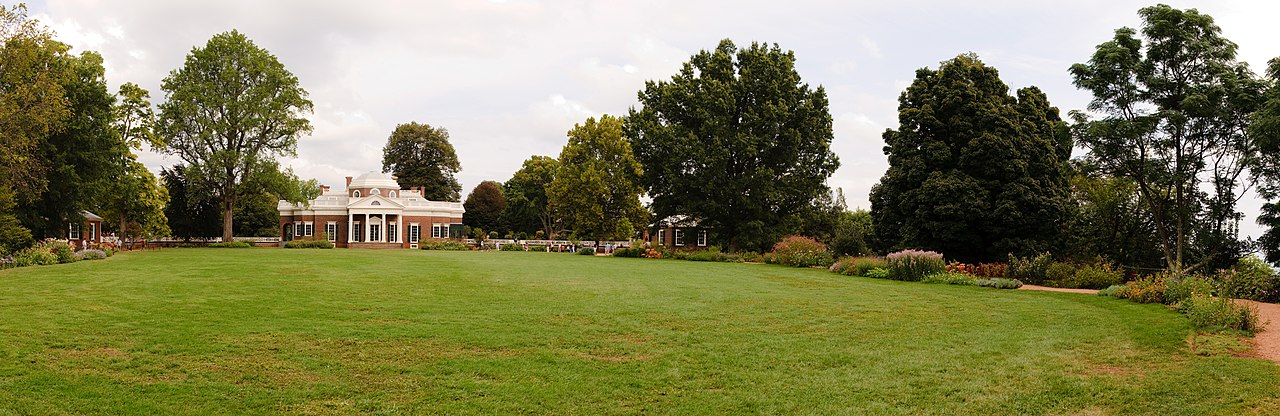
"Monitcello 47MP" by Sbuckley - Own work. Licensed under CC BY-SA 3.0 via Wikimedia Commons -
Thomas Jefferson wrote to artist Charles Wilson Peale, “No occupation is so delightful to me as the culture of the earth, and no comparable to that of the garden. I am still devoted to the garden. But though an old man, I am but a young gardener.”  Although Jefferson redesigned the gardens on the White House grounds and planted hundreds of seedling trees, his true passion was
Monticello.

Available on Amazon
Monticello, Jefferson's masterpiece, was probably the grandest private garden and collection of plants in its time.  Originally a tobacco plantation, the majority of its 5000 acres were transitioned to wheat as the markets changed.  Its south facing slope maximizes solar aspect and terrace holds water and reduces erosion.  The vegetable garden is 1,000 feet long and grew over 300 varieties of vegetables.  Below, are six acres of nearly 170 different fruit varieties.  He also planted groves for his "pet trees."  Jefferson is buried at Monticello, dying only a few hours before his friend and fellow Founder John Adams.


On James Madison's retirement from the Presidency (4th President), he returned to his estate, Montpelier, and championed sustainable farming practices and resource conservation.

John Quincy Adams, John Adams's son and sixth president, implemented many of Jefferson's plans and personally planted many seedling trees including fruit trees, along with herbs and vegetables.  More recently, a Victory Garden was planted at the White House during World War II.  The Clinton's had trouble convincing the White House of the need for a vegetable garden, so they planted a small garden on the roof.

First Lady Michelle Obama and White House Chef Sam Kass
show students how to plant a garden
Our current President Barrack Obama and his wife, Michelle, have reinstituted the White House kitchen garden after years without.  In addition to fruits, vegetables and herbs, the garden includes a bee hive and composting bins.  Motivated by the lack of nutrition in the modern American diet of their daughters, a garden was an easy way to get more fruits and vegetables.  It is also used to promote healthy eating and local food.  The surplus is also shared with local charities.

I wish you a happy President's Day, and however you celebrate, think of the rich botanical heritage the first four Presidents planted in the fertile soil of our new Republic, and the return of those interests in our current President and hopefully beyond!
By the way, in honor of President's Day, national parks, wildlife refuges and other public lands are FREE!  Or if you can't travel to one of these destinations, follow the links to learn more about Mount Vernon and Monticello, they are truly amazing!