Abundant Design, LLC provides Des Moines and Central Iowa with Edible & Sustainable Landscaping, Regenerative Land Use Consulting, Permaculture Design and Installation services.
Our Mission:
Our Mission: To enable individuals and communities to take an active part in the cultivation of systems that provide the highest quality fruits, vegetables, herbs and other yields, in a way that benefits themselves, cares for the land and environment, and provides a surplus to use, share and reinvest into the system.
A little late on the post this week. As the weather changes, and there is less and less daylight each day, I've been trying to spend more time with and reconnect with my family. I'm very excited for this Thanksgiving holiday!
Work still continues, and yesterday dug in the water catchment swales/rain gardens at the healing garden project. I'm thankful for the beautiful weather before this chilly wind rolled in.
What is a swale? A swale is a ditch for collecting water, generally to move it elsewhere without undue erosion. In my projects we usually use a swale on contour, meaning it is nearly level and water collects and soaks into the soil hydrating it. If there is too much rain, it will move off site in a controlled manner, but we try to infiltrate as much as we can into organic matter rich soil for our plants use.
This video shows one of this summer's rain garden projects where we elongated them to act as hydrating features of the landscape, which will drought-proof the hazelnut, aronia and raspberry plantings.
Video Tour of a large Rain Garden
Back to the healing garden, I am also thankful for Beemer Landscaping who did the initial site grading for the walking paths. I've also used them for some retaining walls and other projects. Their water features are top notch and Korey and his team have won awards at home shows where I have had feature gardens.
I'm also thankful for Bob and Tessa at Blooming Prairie Nursery. I have had Bob help me on a couple projects and purchased many plants from them, check them out for your prairie and native plant needs.
Brandon at Browne Atlas has also been a friend and cooperator of Abundant Design. They have worm castings available and can be used with our landscape installations for an early boost to your plantings.
Will and Jonathan are great guys over at Trinity Tree Care. They have also been a great resource, tree clearing/trimming help and helpful tree care advice.
Although I didn't get to work with Ralph as much this year, I am thankful for his friendship as well. You can help out the Forest Avenue Community Orchard on Giving Tuesday and/or head down there on December 2nd to help with fall cleanup, meet new friends and enjoy refreshments.
I'm also so very thankful for my wife and family and their support this past year as the business has grown and I haven't always been home as much as I should have been. After getting home past dark last night, with two of my kids helping me out, my wife had supper waiting, so I could eat quickly and get to the board meeting at Cherry Glen on time.
Organic matter feeds healthy soil life, improves the water holding capacity of sandy soils and the workability of clay soils.
Recently I shared an article on Facebook about how Backyard Abundance, very similar to Abundant Design, is encouraging people to keep their leaves, and even ask for more. Here's the local news video talking to their director Fred Meyer.
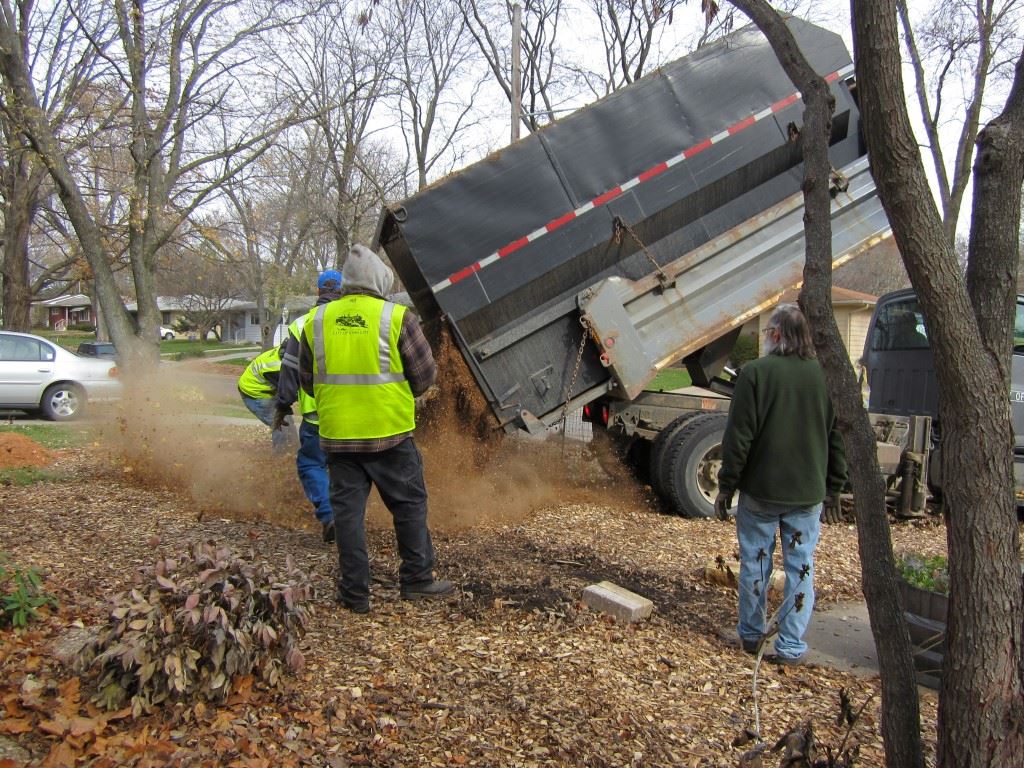
Well, one of my customers from this summer took that advice, and we arranged a load of leaves to be delivered.
The load arrives, right next to the Norway Spruce we planted
He has been grooming his lawn for some time and it really looks great. Unfortunately homes in newer suburban developments are notorious for having poor soils, low in organic matter.
Buy on Amazon (affiliate)
More recently they've been looking for natural approaches, from using Milorganite and spent coffee grounds in the lawn, adding a butterfly and vegetable garden, composting and our recent project.
We planted several trees and shrubs to enhance the windbreak and shade their home in summer, along with a strip of native prairie plants for pollinator habitat. Next stages will include a larger vegetable space, natural playscape and possibly a rain garden.
These leaves are a great natural addition to the soil building efforts going on, that won't contaminate the soil or groundwater, but could actually improve it.
I attended a training workshop to be a Prairie STRIPS consultant this week. More on that training in the near future and how Abundant Design can help reduce nutrient and topsoil loss on your farm.
Grass identification slide
Last week was also the ground breaking on the Healing Garden at the East side clinic. Very excited to see how that develops and grows over the next couple years!
Now is the perfect time to get a design started for your project. Be ready to go next Spring!
As the harvest comes in I see a lot of bare fields...
"What's strange about that, the harvest is in?" you might ask.
Well, for many years now cover crops have been a topic of discussion and the farmers and land owners experimenting with the practice have had great results - including yield increases, improved soil health and less erosion. And year over year the data shows more and more growers are using them. But by now, I would have thought there would have been a rapid adoption of cover cropping almost everywhere, along with more and more using no-till practices. The combination can add $100/acre profit!
Here is an email conversation from several years back where I was sharing with my supervisor about cover crops and soil health...
"Part of my performance plan is to share insights of the soils classes I’ve taken and how that relates to our work here.
I have not taken much time for the online classes since the cover crop workshop, but here is a quick video to share from the USDA NRCS that kind of ties together soil health, the industry’s renewed push for biologicals and our company's beginning interest in cover crops."
Thanks for sharing, Jeff! Your interest in sustainability brings another dimension to how we think about agriculture and that is always a good thing.
The expert in the video mentions diversity of crops is best for soil microbe health. Do you think that simple crop rotation is enough to do this? Crop rotation has been a best practice, however I understand sometimes this isn’t done. So are cover crops used in the winter in soy and corn fields? Or are they planted somewhere else?
Thanks,
I don’t know percentages of acres growing continuous corn vs corn-soy rotation. Some growers have also included oats or alfalfa in a multiyear rotation plan, but I think those numbers have really decreased.
However simple crop rotation is not enough for good soil health and conservation. The large amount of time the soil is left exposed to the elements contributes to erosion. Nitrogen off gasses from soil >50°F, the gap from harvest until the soil cools and from warm up to the new Spring growth; fields can lose much of the added benefit if anhydrous or manure is applied at these times. Probably the biggest effect on overall soil health is that the rhizosphere is left without living roots. These are an important piece in the soil food web.
Cover crops are a really great step to bridge the gaps between growing seasons in corn, soy or other annual crops. Late summer aerial seeding into existing stands, planting cover seed at harvest or soon after can have good results too. Cover crops keep the soil biome active (although its much slower in winter) by sustaining the microorganisms with living roots. They also protect the soil from exposure, and the roots help hold soil in place. They take up nutrients and store them in their tissues until released through decomposition post termination.
Use of cover crops is growing but adoption has been quite slow. The combination of no-till and cover crop systems takes ~3years to get established and that plays a big part I think, especially on leased farmland.
If you have more questions just ask, I really like talking about it :)
Spread the word about Cover Crops!
Jeff
Thanks for the extra information, Jeff! Cover crops sound like a good tool to use. Hopefully they will continue to gain ground :)
I encourage you to consider cover crops, or talk to your friends and neighbors that haven't. These are one way to help our soil, water and environment without a major change to a conventional corn and soybean operation. Resources are available to assist you through the USDA NRCS, USDA SARE, Practical Farmers of Iowa and more.